

This is the first in a four-part series exploring how people actually use AI today. In this post, we examine who is using these tools—and why the demographics defy every expectation about technology adoption. Future posts will cover the most popular use cases at home, emerging applications that are growing rapidly, and how AI is being used in the workplace.
In June 2025, OpenAI’s researchers analyzed 1.5 million conversations across ChatGPT’s 700 million weekly users—the largest study of actual AI behavior ever conducted. What they found contradicted nearly every prediction experts had made about AI’s adoption trajectory.
Note on the data: This analysis is based primarily on OpenAI’s National Bureau of Economic Research (NBER) working paper “How People Use ChatGPT” released in September 2025, conducted by OpenAI’s Economic Research team and Harvard economist David Deming. While other AI tools like Claude (see Anthropic’s Claude usage research) and Microsoft Copilot have released their own studies, ChatGPT’s data has two key advantages: scale (700 million weekly users) and methodology (based on actual anonymized prompts rather than self-reported surveys). For understanding how people really use AI—not how they think they use it—ChatGPT’s dataset offers the most accurate picture available.
What the demographics tell us
The demographics of AI adoption defy the typical patterns of technology adoption. Where most new technologies start with young, male, technical users in wealthy countries and take years to reach broader audiences, AI is spreading in ways that challenge all of these expectations.
This matters because understanding who is actually using these tools—and how quickly adoption is democratizing—reveals something fundamental about AI’s trajectory. This isn’t following the iPhone playbook or the social media playbook. This is something different.
Gender: The Fastest Reversal in Tech History
In January 2023, when ChatGPT was still new, about 80% of its users were male—a pattern familiar to anyone who’d watched the early adoption of smartphones, gaming consoles, or social media platforms. New technology always started with young men, particularly those with technical interests and disposable income.
But by July 2025, something extraordinary has happened. Women now comprise 52% of ChatGPT’s user base—slightly more than men.
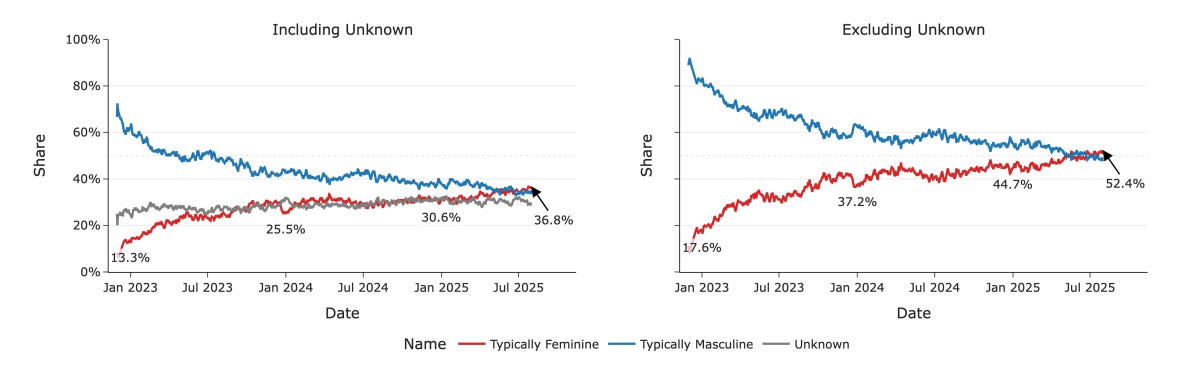
This is one of the fastest demographic reversals in tech history. The iPhone took years to achieve gender parity. Facebook, which was considered unusually mainstream for a tech platform, took even longer. ChatGPT has done it in under two years.
The usage patterns show interesting gender differences: men are more likely to use ChatGPT for technical help and image generation, while women gravitate toward writing assistance and practical guidance. But the deeper story is about accessibility. AI has jumped from being a tool for tech enthusiasts to something genuinely useful for ordinary tasks—the kind of everyday problems that don’t require any technical background to understand or appreciate.
Geography: The Democratization No One Expected
The shift isn’t just about gender, geographic patterns are equally surprising. Adoption in the wealthiest countries—the United States, Western Europe, Japan—has grown steadily but predictably. The real acceleration is happening elsewhere.
By May 2025, ChatGPT adoption growth rates in the lowest-income countries are over 4 times faster than in the highest-income countries. Middle-income economies like Brazil, India, and Mexico are seeing adoption rates nearly on par with advanced economies—roughly 20-30% of internet users in these countries are using ChatGPT regularly, up from single digits just a year earlier.
This is democratization on a scale rarely seen in technology. The usual pattern—wealthy nations adopt first, everyone else follows years later—is being compressed into months. ChatGPT’s free tier means that anyone with internet access, regardless of income or location, can use the same tool that Silicon Valley executives are paying $20 per month for.
The breakdown by economic status:
Advanced economies (GDP per capita $30,000+): ~30% of internet users use ChatGPT
Middle-income economies ($10,000-$30,000): 20-30% of internet users
Emerging economies ($3,000-$10,000): 15-20% of internet users, growing rapidly
Low-income countries (<$3,000): ~5% of internet users, but with growth rates 4× faster than wealthy nations
This democratization so early in a product’s lifecycle is very rare - It means that AI adoption isn’t being shaped primarily by Silicon Valley or by wealthy Western nations. The use cases, the cultural adaptations, the problems being solved—all of this is being influenced by a truly global user base. A teacher in São Paulo, a small business owner in Mumbai, and a retiree in rural America are all shaping how these tools evolve.
Age: Not the Demographic You’d Expect
Age patterns reveal a different kind of surprise. The highest adoption rates aren’t among teenagers or college students—they’re among working professionals aged 25-45.
About 34% of workers under 40 use AI regularly, compared to just 17% of those over 50. This seems to contradict the stereotype that young people automatically embrace new technology faster than everyone else.
But look closer and the pattern makes sense. Teenagers have less need for AI—their problems (homework, social coordination, entertainment) can be solved with existing tools like Google, group chats, and TikTok. Young professionals, meanwhile, face a different set of challenges: emails that need to sound professional, reports that require synthesis of complex information, meetings that generate pages of notes. For them, AI isn’t a novelty—it’s a solution to real friction in their daily work and life.
The most interesting group is older adults over 55. They have the lowest adoption rates, but among those who do start using AI, satisfaction scores are the highest of any demographic. Once the initial barriers—unfamiliarity with chatbots, uncertainty about what to ask—are overcome, they discover uses younger adopters often overlook: understanding medical terminology, corresponding with grandchildren in another country, researching complex purchases like cars or insurance.
Education: The Great Equalizer
Education tells perhaps the most nuanced story. About 40% of workers with a bachelor’s degree or higher use generative AI, compared to about 20% of those without a college degree. On the surface, this suggests a significant education gap in adoption.
But when researchers control for age, gender, and type of work, something remarkable emerges: the differences nearly disappear. College graduates and non-graduates use ChatGPT in remarkably similar ways:
Writing: ~30% for both groups
Practical guidance: ~28% for both groups
Seeking information: ~20% for both groups
Technical help: ~7% for both groups
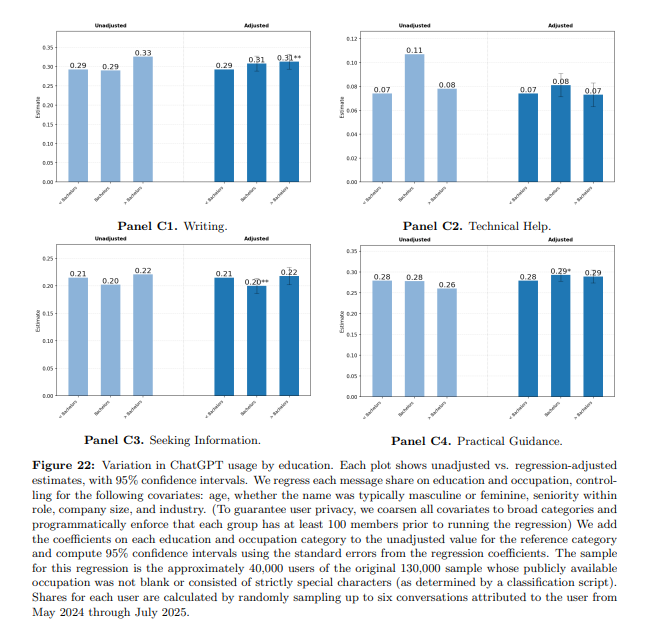
The tool is proving to be one of the great equalizers—not because it eliminates skill differences, but because it provides similar value regardless of educational background. A college graduate using AI to polish a business email and a high school graduate using it to draft a customer service response are both getting comparable benefits: clearer communication, time saved, reduced anxiety about whether their writing sounds professional.
What This All Means
The pattern that has emerged is clear: AI adoption is spreading far beyond the early-adopter demographic of young, male, technical users in wealthy countries. It is becoming genuinely mainstream in a way few technologies have managed so quickly.
Unlike many technologies that primarily benefit those who already have advantages (education, resources, connections), AI tools seem to provide proportional value across education levels. The calculator helped everyone do arithmetic, regardless of whether they’d studied advanced mathematics. AI writing assistance appears to work similarly—it helps everyone communicate more effectively, regardless of their formal education in composition.
The users driving ChatGPT’s growth to 700 million aren’t who tech leaders predicted. They are:
Teachers in São Paulo using AI to explain complex concepts to students
Retirees in Florida figuring out their medical bills and insurance claims
Parents in Mumbai helping kids with homework in subjects they never studied
Small business owners in Mexico City drafting emails to customers in better English
Office workers in Jakarta researching how to create pivot tables in Excel
Students in Lagos seeking information about scholarship applications
This means AI’s evolution is being shaped by a genuinely diverse global user base with wildly different needs, languages, and contexts. The applications that emerge, the features that get prioritized, the use cases that prove most valuable—all of this is being determined not by a narrow slice of early adopters, but by hundreds of millions of people across every demographic.
Coming next: In Part 2, we’ll examine what these 700 million users are actually doing with AI—and why 73% of usage has nothing to do with work. The most popular use cases reveal a technology that’s changing not how we work, but how we live.
Read the series:
Part 1: Who’s Using AI? (you are here)
Part 2: The Most Popular AI Use Cases at Home (coming next)
Part 3: Emerging AI Applications That Are Growing Fast (coming soon)
Part 4: How AI Is Actually Being Used at Work (coming soon)
This article comes at the perfect time! I was so eager for this series; the demografics you found are truly mind-blowing.