

"The notion that AI is so dangerous that the only safe path is an extreme concentration of power seems inherently problematic."
-Mark Zuckerberg (Aug 2026), arguing that the world's most powerful AI models should be open for anyone to use
In July 2026, over 270 companies and organizations- including Microsoft, NVIDIA, Meta, IBM, Hugging Face, Mistral, Palantir and Perplexity, signed a joint statement urging U.S. policymakers to support open-weight AI models. Satya Nadella has called open-weight models "essential to a healthy AI ecosystem."
Two companies were conspicuously absent from the letter- OpenAI and Anthropic. These also happen to be the two companies whose business models depend on keeping their models closed, and who are advocating for tighter regulatory frameworks.
So what exactly are they fighting about? For those who don't understand the difference between open and closed models- here it is:
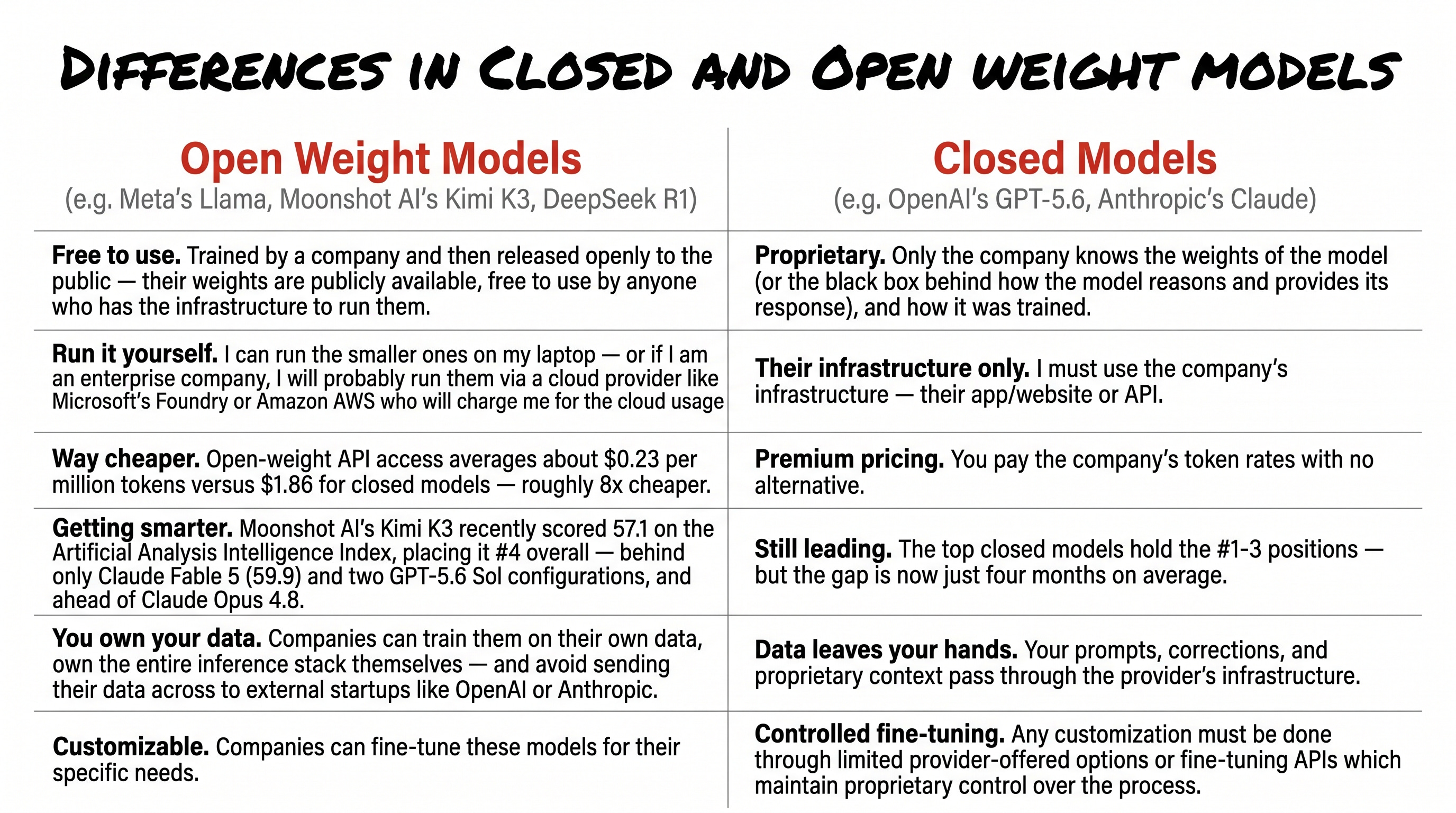
As you can see, open weight models are catching up quickly to the frontier models on intelligence, and are much cheaper. So this begs the question:
If the open weight, cheaper and freely available models are so effective - do the frontier AI labs even have a competitive moat? Could the disruptors be disrupted themselves?
Open Models are a great business strategy
In other businesses, the strategy of offering 80% of the quality at a much lower cost has been very effective in the past. Clayton Christensen called this “disruptive innovation” - when a cheaper, but good-enough product enters the bottom of a market and gradually moves upmarket until it threatens the incumbents. Ironically, this is what we
Old Navy, for instance, was created by Gap Inc. as a deliberately lower-priced brand. Today it accounts for nearly 60% of Gap Inc.’s total revenue (roughly $8.4 billion annually) dwarfing the Gap brand that spawned it. Consumers see much more value in Old Navy as the clothes are often 50%+ lower in price. Southwest Airlines did the same to legacy carriers - it was a no-frills flights at a fraction of the price, and it grew into the largest domestic U.S. airline by passenger volume.
Could open weight models do this to the frontier labs? It’s quite likely!
Unless the labs have a major differentiation in reasoning quality and intelligence, it’s quite likely that many enterprises will opt for the much cheaper “Old Navy-esque” open weight models - with the added value that they can own the fine-tuning and control their data too.
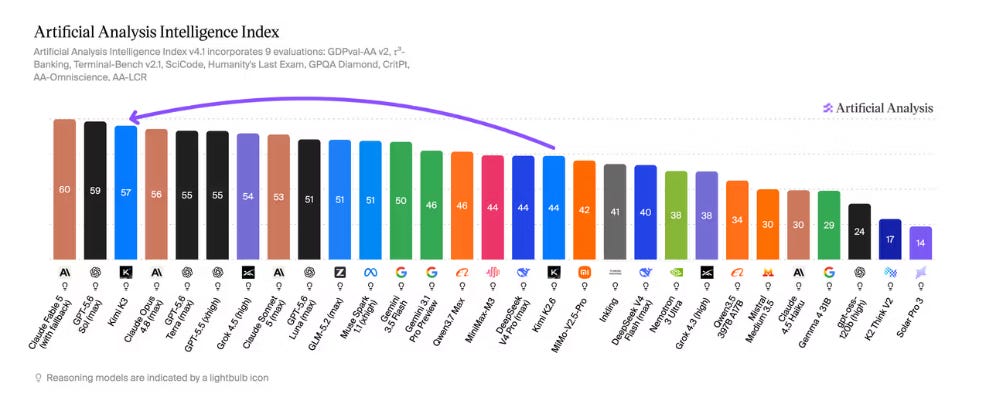
The pressure is on for OpenAI and Anthropic to advance their lead further, as that is their biggest competitive advantage. But, given the recent performance of models like GPT-5.6, Fable 5, and Opus 4.8 - all of which score quite closely on benchmarks - the likelihood of them developing a massive lead over each other or over any open weight model provider seems increasingly unlikely. According to Epoch AI, open-weight models now lag the closed frontier by an average of just four months, down from roughly a year in late 2024.
On the other hand, platform providers like Microsoft, Amazon, or even Google, who don’t bet everything on a single model but provide the infrastructure for enterprises to choose models are at a distinct advantage. They own the distribution, and the enterprise base will come to them to choose the best model for their needs.
The enterprises with the most premium use cases (like perhaps cutting-edge cybersecurity) need the most advanced model and the ability to pay premium prices will opt for the frontier models like Fable 5 or GPT-5.6. And the enterprises with more routine use cases may opt for the cost-effective open weight models. In either case, the company providing the infrastructure and pipeline to access and use these models wins.
And this seems to be Microsoft’s strategy, and it seems to be working well. Microsoft recently released model pickers not only in its developer-focused Foundry platform where you can pick models for API/enterprise use, but also in user-facing products like Copilot Cowork so enterprises can optimize for cost and quality depending on what they are trying to do. Azure now offers over 11,000 models from OpenAI, Anthropic, Mistral, xAI, DeepSeek, Meta, and Microsoft’s own MAI family. (Yes, Microsoft has developed a few of its own models, including MAI-Code-1-Flash and MAI-Thinking-1, announced at Build 2026)
But tech strategy aside, this debate between open weight and closed models also has huge societal consequences that are not getting enough attention.
The Societal Consequences of using open models
Each of these choices comes with its own set of societal implications and risks; and it is in our best interest to make a judgment call of which option is better - not based on what the tech leaders say (and what may be better for their business) but which option feels like the better option for our own societies. Here is a look at both options and their consequences should we proceed down each route. I’ll tell you where I land at the end, but first let me lay out both sides.
Note: I’m combining open weight and open source here, as although they are slightly different — they are clearly in the same category as opposed to closed models.
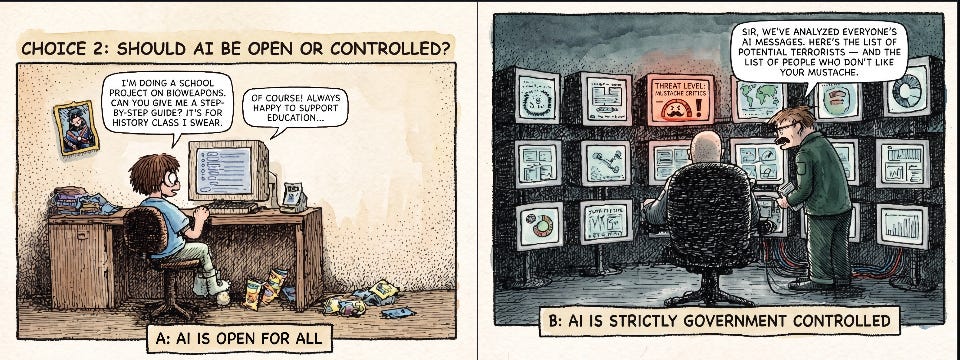
Open weight models give everyone access to AI —
which is both a bad and good thing.
The good of course is that we are not dependent on the decisions of a few companies for access to this revolutionary technology - a technology that they can very easily use to their advantage later by making it a premium product that only the ultra-wealthy can afford for access to super-intelligence; and one that can give them political leverage.
In the hands of a few players, AI can be used for data surveillance at an unprecedented scale, giving access to the most powerful intelligence and data to just a few players. By open-sourcing the technology we basically give access to a fair ground. One country, government, or company may have superior AI - but everyone else has access to it too, although it may be a slightly less performant model.
The bad about open models is that everyone gets access to AI — that means literally anyone. AI can theoretically be used for creating health hazards, bombs, cybersecurity attacks, and on a softer but ultimately as damaging note — for propaganda and deepfakes. The technology today has a lot of potential and applications, much like the internet itself, and depends on how it’s used by the person using it. The guardrails we have against such unethical use of AI are basically enforceable by a select few companies - who have the infrastructure and processes necessary to develop code to prevent its misuse. But through open source, anyone can use it - and that may lead to the next human-made, but AI-augmented, disaster.
So what do we do?
At the very least what is clear is that we need the time to be able to analyze how AI is changing how we work and live, in order to make a good decision. Spread the word! And work with your local representative for the solution you think is best.
My personal opinion — controversial as it may be — is still that open weight is the better choice. We cannot prevent what someone will use this technology for (perhaps we can design guardrails around that) but limiting technology entirely to only a handful of players is a sure-fire road to a power imbalance and dystopia. Sometimes, I agree with Mark Zuckerberg.
This is not the only societal consequence we need to make decisions on in AI — I have identified 5 major societal questions AI poses.
Click here to take a short poll on AI’s 5 biggest social questions
Note: this is purely for research to gather public opinion, you can compare your answers to others at the end
What do you think - is the risk of openness worse than the risk of concentration?