

I recently shared my insights on the latest research on how AI is impacting jobs, and specifically how the PM role will evolve, at the AI PM Summit. Here are the most important takeaways:
Also check out book Indispensable: Your Career Guide for the Age of AI, with detailed predictions for 100+ US professions, tips on how to use AI, and which human skills to work on.
1. Don’t be overwhelmed — your job is safe for now
This is the most important point I want to make — we are seeing Jevons’ Paradox play out in real time in software development. Although it appears as though engineering and PM jobs will reduce, they will likely go up.
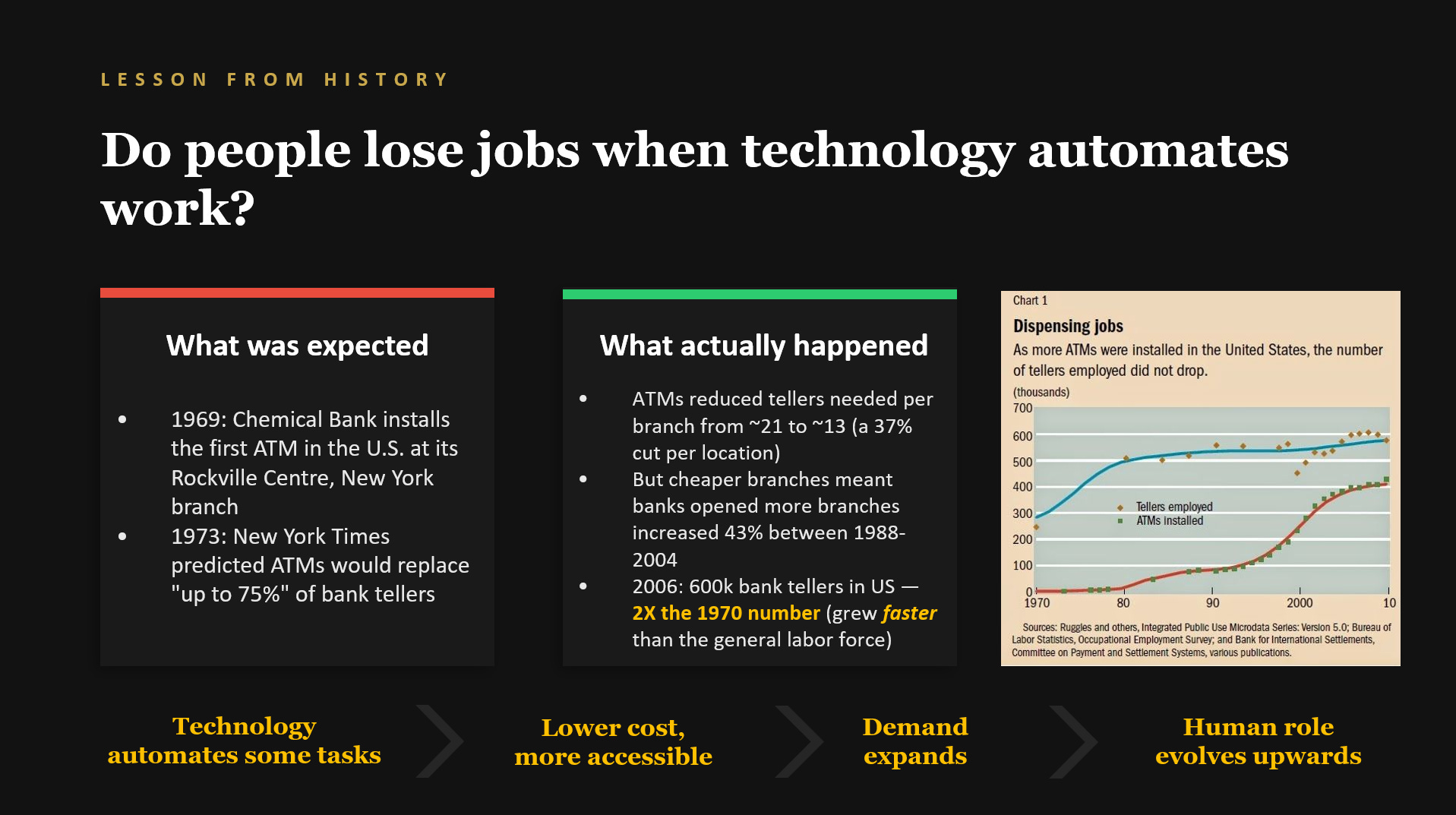
Everyone predicted ATMs would kill bank teller jobs. In 1973, the New York Times said up to 75% of tellers would be replaced. ATMs did reduce tellers by 37% per branch — but overall, teller jobs actually doubled over the next 30 years, growing faster than the general labor market. Why? Cheaper branches meant banks expanded into underserved areas, and they still needed people to do what ATMs couldn’t — answer questions, advise customers, build relationships. The pattern: technology automates some tasks → lower cost, more accessible → demand expands → the human role evolves upwards.
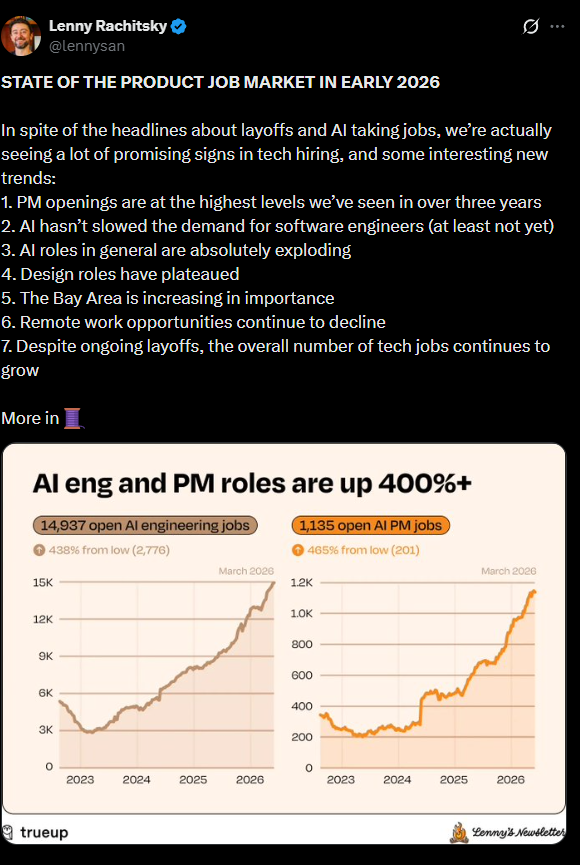
The same pattern is playing out in software development right now. When ChatGPT launched in 2023, everyone predicted programming was dead. The reality? Software engineering and PM jobs have gone up. AI is writing more code than predicted, but demand for AI and software has also surged.
Adoption is still under 50% in most industries — so it’s probably looking quite safe from a five-year perspective. The overwhelm comes not from whether you’ll have a job, but from the fact that your job itself is transforming.
2. Knowing when NOT to use AI is the most important skill.
There is a misconception that if you plaster AI onto everything, it will make you more productive. That is not true. Research from the brilliant Ethan Mollick at Wharton shows that when AI is good at a task and you have the expertise to steer it, you get great results — 12.2% more tasks completed, 25.1% faster, at ~40% higher quality. But when you ask AI to do something it’s not good at and you lack the expertise to steer it, you produce worse output than had you not used AI at all.
The researchers called this “falling asleep at the wheel.”
Worse still: if you delegate tasks to AI and don’t steer the ship, it will atrophy your own skills. You’ll become worse at the things you already know how to do.
The biggest skill right now is knowing where to offload to AI and where not to.
3. To be an AI-Powered PM, break your job into tasks and categorize them by AI capability.
The research on how jobs evolve with AI converges on a clear framework: jobs are bundles of tasks (Brynjolfsson, Mitchell & Rock, 2018).
Break them down, categorize each by AI augmentability — tasks can be AI-led, AI-human collaboration, or human-led (Anand & Wu, 2025, Harvard Business Review).
The tasks that remain human are high on empathy, presence, opinion, creativity, and hope (Loaiza & Rigobon, 2024/2025, MIT Sloan).
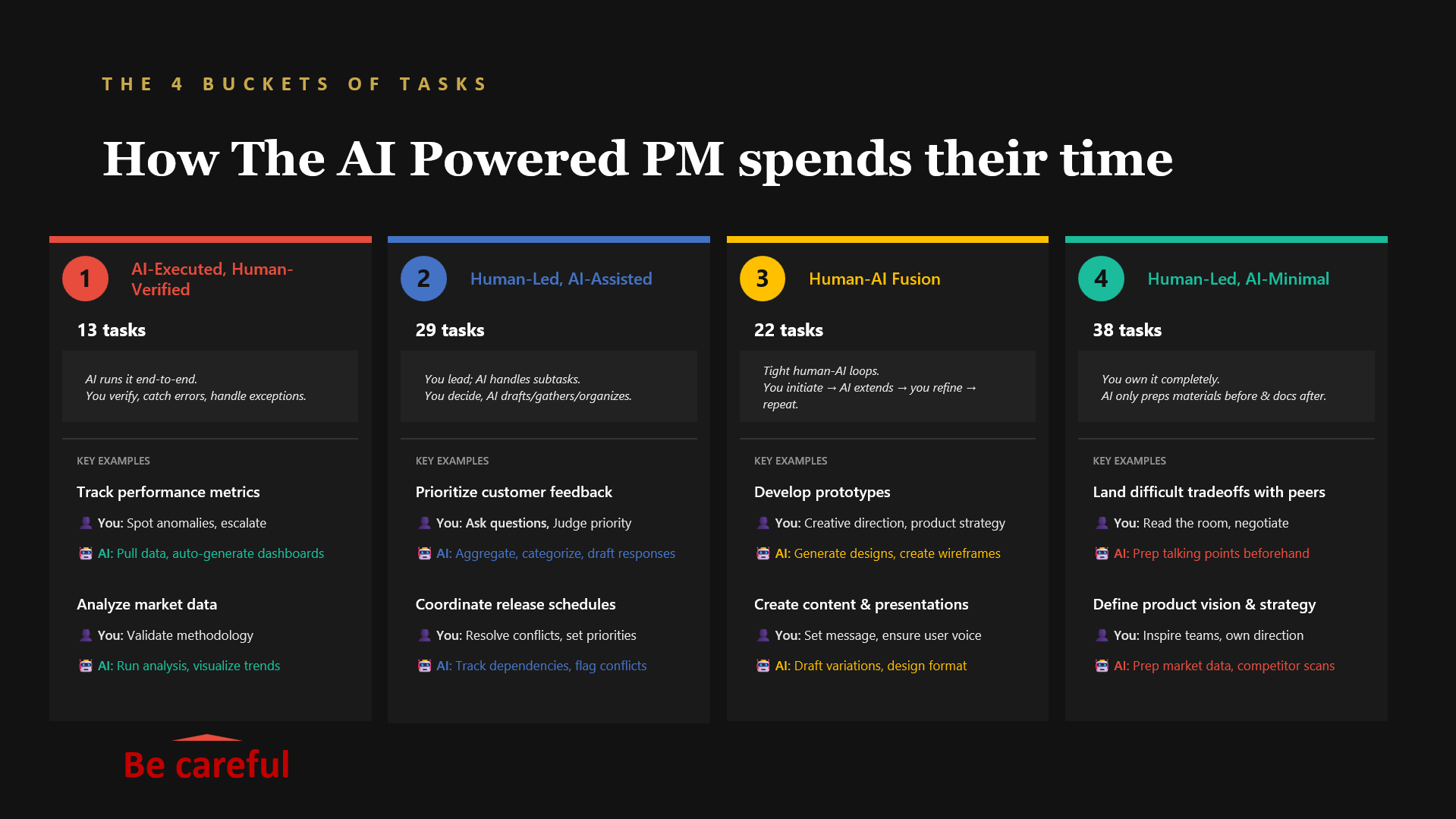
I did this for the PM role — 102 tasks across 4 buckets:
Bucket 1: AI-Executed, Human-Verified (13 tasks). AI runs it end-to-end. You verify, catch errors, handle exceptions. Very few tasks belong here. Be careful — this is where most people start, and it’s where AI makes the most incorrect assumptions. Example: performance tracking — let AI pull telemetry, build dashboards, analyze trends. You interpret and decide.
Bucket 2: Human-Led, AI-Assisted (29 tasks). You lead; AI handles subtasks. You decide, AI drafts/gathers/organizes. Example: customer feedback — the quality comes from the questions you ask, not the processing. Ask the right questions, read between the lines, then let AI aggregate and categorize.
Bucket 3: Human-AI Fusion (22 tasks). Tight human-AI loops. You initiate → AI extends → you refine → repeat. Example: prototypes — if you just hand it to AI, it won’t respect your company’s design constraints or product direction. You need to be extremely precise, set the direction, and mold the output. It may take more time, but the result is better than without AI.
Bucket 4: Human-Led, AI-Minimal (38 tasks). You own it completely. This is the most important bucket. Most PM tasks live here — landing tradeoffs, getting people aligned, driving hard choices. These are the tasks that make you indispensable. Don’t use AI for this. Resist the urge. If someone tells you there’s an AI agent that can get consensus in a meeting, it’s a horrible idea.
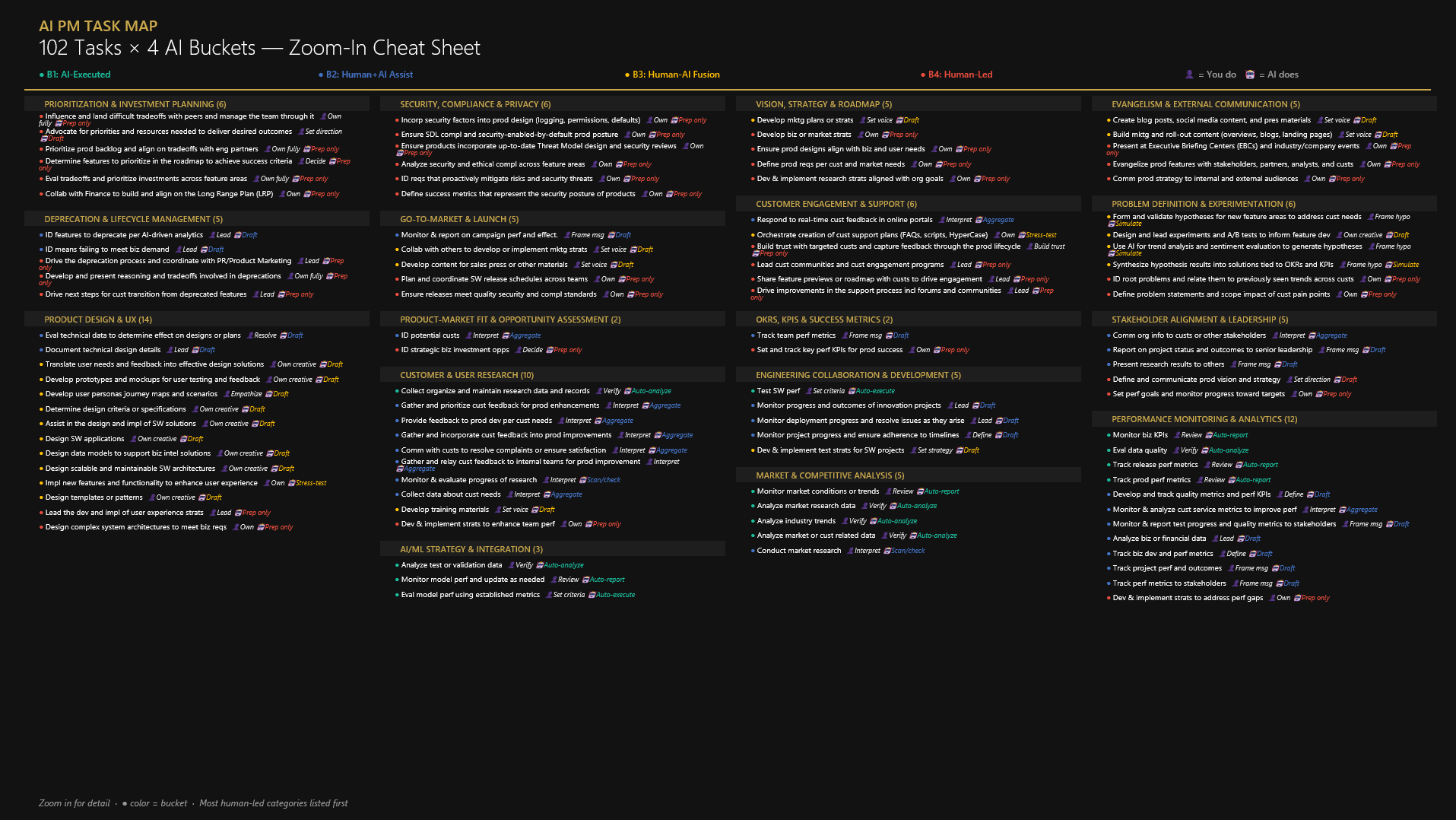
Here is the full cheat sheet - everything a PM does, broken out by bucket:
4. Soft skills are the hard skills now.
Here are 4 thumb rules-
Integrate Deeply: Engineers, designers, and researchers all have informed judgment now. Everyone is evolving in their roles. Your biggest role as a PM is to be the integrator — listen to every perspective, synthesize them. That’s what makes you the best PM.
Drive with Agency: Your fire and ability to get things out of people is a superpower. Nobody, including the AI, wants to do this. Ask the right questions, engage people and AI with the right prompts, cultivate fire in people to get business results.
Know What AI Can and Cannot Do. See above. Continuously adapt your workflow as new tools arrive. But the biggest skill is knowing when to NOT apply AI. Develop that judgment.
Stay Hungry, Stay Foolish. The career ladder is dead. People are leaving VP-level roles for IC roles because skills, depth of expertise, and judgment are the real assets now. Keep upskilling. Keep learning. Keep showing your impact.
AI is bringing the biggest transformation in work of our time — and I’m trying to help everyone prepare for the shift. I’ve written a book, Indispensable: Your Career Guide for the Age of AI, with detailed predictions for 100+ US professions, tips on how to use AI, and which human skills to work on. I’ve also built a free career tool to help you explore how your specific occupation will evolve. Order the book and check it out here.
Research References
Brynjolfsson, Mitchell & Rock (2018), “What Can Machines Learn, and What Does It Mean for Occupations and the Economy?”
Anand & Wu (2025), “The Gen AI Playbook for Organizations” — Harvard Business Review
Loaiza & Rigobon (2024/2025), “The EPOCH of AI: Human-Machine Complementarities” — MIT Sloan
Mollick et al. (2023), “Centaurs and Cyborgs on the Jagged Frontier” — Wharton / One Useful Thing
Dell’Acqua et al. (2023), “Navigating the Jagged Technological Frontier” — Harvard Business School