

This is the second in a four-part series exploring how people actually use AI today. In Part 1, we examined who is using these tools and discovered adoption patterns that defy typical technology trends. In this post, we dive into what these 700 million users are actually doing—and why it has almost nothing to do with work.
When OpenAI’s researchers analyzed 1.5 million conversations from mid-2025, they discovered something that contradicted every prediction about AI’s future. The technology everyone assumed would revolutionize the workplace was barely being used at work.
Seventy-three percent of ChatGPT’s messages—three out of every four conversations—had nothing to do with jobs, productivity, or professional tasks. People weren’t asking AI to write business proposals or analyze spreadsheets. They were asking it to explain their medical test results. To suggest dinner recipes. To help them understand why their teenager was acting withdrawn. To translate a text from their grandmother in another language.
This wasn’t what the technologists predicted. But this was what was actually happening.
The conversations weren’t scattered randomly across hundreds of use cases. They were concentrated. Nearly 80% fell into just three broad categories: Practical Guidance, Seeking Information, and Writing. Most people, it turned out, were using the world’s most advanced AI to do remarkably ordinary things.
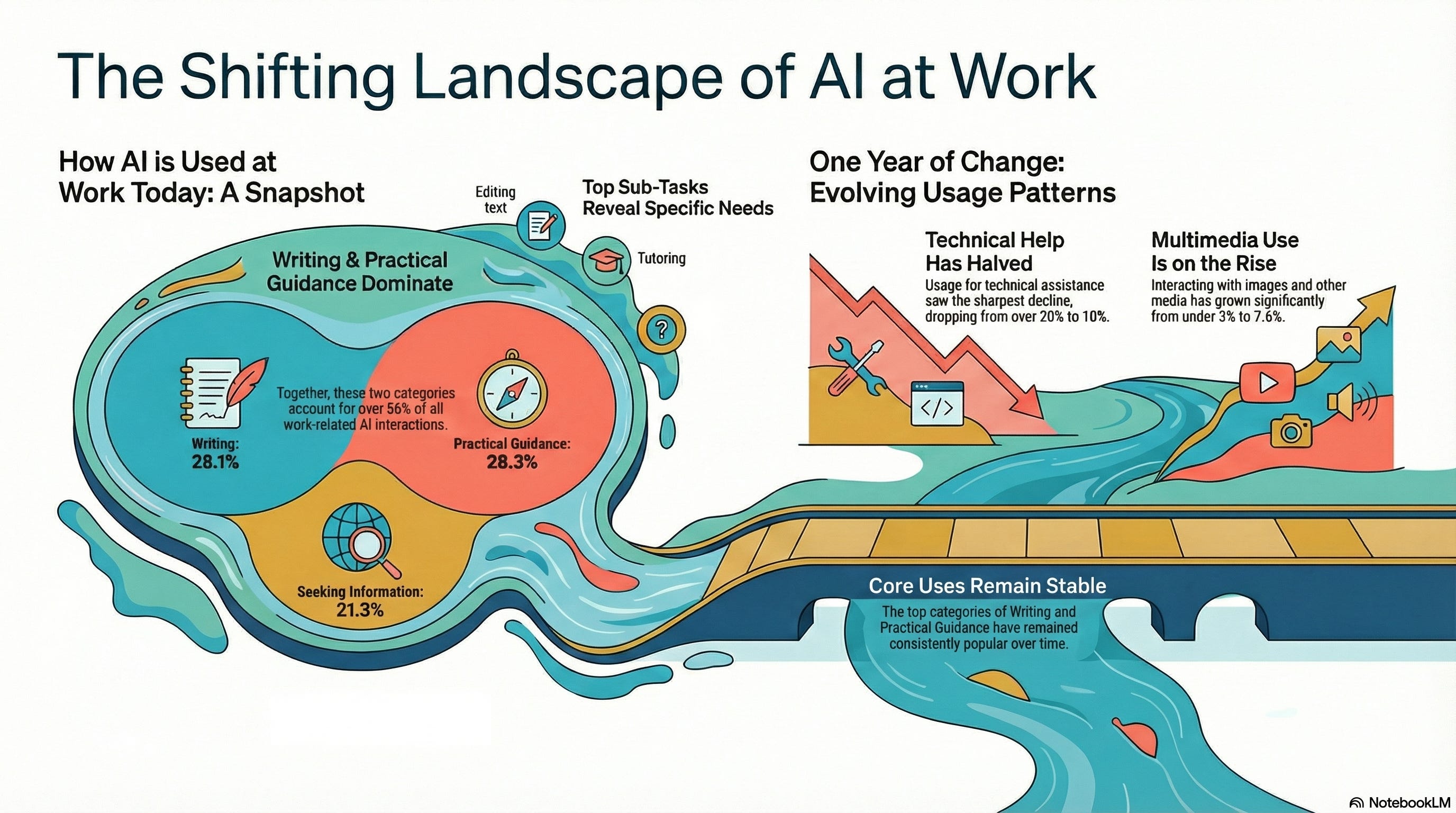
Practical Guidance: The AI Advisor (28% of all use)
The most common way people use ChatGPT isn’t to write or search—it’s to ask for advice. Nearly one in three messages falls into what researchers call “Practical Guidance”: the digital equivalent of calling your smartest friend when you’re stuck.
The actual queries reveal how people really talk to AI:
“I have chicken breast, half an onion, and some random vegetables in my fridge. What can I make for dinner in 30 minutes?”
“My 8-year-old asked me to explain photosynthesis and I totally blanked. Help me explain it in a way that makes sense.”
“I want to lose 15 pounds before my sister’s wedding in June. What’s actually realistic and safe?”
These aren’t the world-changing queries tech evangelists promised. They’re ordinary problems that everyone faces. Previously we had to solve them through a combination of Google searches, cookbook and internet browsing, and asking relatives. But now there’s a shortcut—an AI that talks back, remembers context, and doesn’t judge you for not knowing how photosynthesis works.
This category includes tutoring and teaching, how-to advice on various topics, health and fitness guidance, and creative ideation. The AI is trained on nearly all information known to humanity, which makes it remarkably good at providing practical guidance on an enormous range of topics. Today those topics include how to lose weight, ideas for recipes based on what’s in your fridge, and how to explain scientific concepts to children. Tomorrow they might include more complex questions about political philosophy or how to market a business to the right consumer base.
Seeking Information: The Google Shift (24% of all use)
But it’s the second category that hints at AI’s potential to reshape entire industries. By mid-2025, nearly one in four ChatGPT queries fell into “Seeking Information”—questions about current events, products, recipes, people. These weren’t new types of questions. They were old questions, the kind people had been typing into Google’s search box for two decades.
“Best restaurants in Austin.”
“Why is my car making a clicking sound?”
“How do I get red wine out of carpet?”
The irony wasn’t lost on anyone: the transformer technology powering ChatGPT had been invented at Google. Now that same innovation was threatening to undermine the search business Google had dominated for decades.
The shift seems small on the surface. Instead of getting ten blue links and clicking through websites, users now got a direct answer in paragraph form. But that small change had enormous implications. Google’s entire business model—the architecture that generates $80 billion in annual advertising revenue—depends on people clicking those links. If the AI gives you the answer directly, why would you visit anyone’s website? And if you don’t visit websites, how can Google charge advertisers for clicks?
Google still commands 90% of search traffic. But for the first time in its history, the company faces a competitor it can’t simply outspend or out-engineer. The competitor is using Google’s own technology. And deploying a similar tool would mean Google voluntarily destroying the advertising model that made it one of the most profitable companies in history. This isn’t a technical problem. It’s a trap.
This shift has profound implications for how each of us uses the web. As AI chat tools become more ubiquitous for search, they’re completely changing how many of us use the internet. Google has traditionally held the role of the “front door” of the internet—the place you go when you don’t know where to go. Now, if search can happen with a conversational query and users don’t need to visit websites at all, most sites and apps will have to find entirely new ways of being “discovered.”
What’s particularly interesting is that while both work and non-work queries grew in total number from June 2024 to June 2025, non-work queries grew as a percentage much faster than work queries. The general public is gaining confidence in the knowledge and judgment of these systems, and some of these searches are clearly replacing traditional web search. ChatGPT is more flexible than web search even for traditional applications like seeking information because users receive customized responses—tailored recommendations, novel content, personalized follow-ups—rather than just a list of links.
Writing: The Invisible Editor (24% of all use)
The third category, Writing, accounts for nearly a quarter of all ChatGPT use—but not in the way you might expect. When researchers analyzed writing-related queries, they discovered something curious: about two-thirds weren’t asking the AI to write from scratch. They were asking it to fix what they’d already written.
“Make this email sound more professional.”
“Fix the grammar in this paragraph.”
“This cover letter is too long—can you cut it to 200 words without losing the key points?”
The AI is functioning less like a ghostwriter and more like an invisible editor, the kind every writer wishes they had reading over their shoulder.
This distinction matters more than it might seem. The fear around AI and writing has always been that machines would replace human creativity—that students would stop learning to write, that authors would become obsolete. But the data suggests something different is happening. People aren’t outsourcing their thinking; they’re outsourcing the mechanical parts of writing that have always been difficult. The organizing. The polishing. The translating of thoughts into proper grammar and structure.
Writing has always been challenging for many people, whether they’re students struggling with assignments or professionals crafting clear communications. AI tools like ChatGPT remove much of the friction from these tasks, helping users organize thoughts, improve clarity, and overcome writer’s block. About two-thirds of all writing messages ask ChatGPT to modify user text—editing, critiquing, translating—rather than creating new text from scratch. This suggests that people prefer to have the AI tweak their own thoughts to make them more presentable and polished, rather than ask it to create something entirely new.
It’s the difference between using a calculator for arithmetic and using a calculator to understand mathematics. One replaces understanding; the other removes friction from the process. Whether AI remains in the first category or drifts into the second remains to be seen—but for now, most people seem to prefer AI as an editor rather than a replacement.
What This Means for the Future
These three categories—practical guidance, seeking information, and writing—account for nearly 80% of how people use AI at home. They’re not revolutionary applications. They’re not the dramatic transformations tech leaders promised. They’re mundane, everyday tasks that collectively shape whether our days feel manageable or overwhelming.
But that’s precisely what makes them so significant.
AI isn’t changing how we work—at least not yet. It’s changing how we cook dinner, how we help our kids with homework, how we understand medical information, how we communicate with people who speak different languages. It’s eliminating the small frictions that used to require either specialized knowledge, multiple searches across different websites, or bothering a friend or family member.
The technology that was supposed to revolutionize the workplace is instead revolutionizing the kitchen table.
Coming next: In Part 3, we examine the smaller but rapidly growing use cases—image generation, video creation, and AI companions—that raise uncomfortable questions about creativity, professional work, and human connection.
Read the series:
Part 2: The Most Popular AI Use Cases at Home (you are here)
Part 3: Emerging AI Applications That Are Growing Fast (coming soon)
Part 4: How AI Is Actually Being Used at Work (coming soon)
This analysis is based on OpenAI’s National Bureau of Economic Research (NBER) working paper “How People Use ChatGPT” released in September 2025, analyzing usage patterns from 1.5 million conversations.