

Our work is more than the tasks we perform as part of our formal job roles.
Knowing what other teams are working on, coordinating with them, exchanging information and ideas, mentoring others while providing and receiving support are all critical parts of any organization’s machinery.
I expected this "invisible work" to become even more valuable in the age of AI. Now, we are seeing some early evidence of this, based on fascinating research from my colleagues. Beyond the Org Chart: AI and the Transformation of Invisible Work · The New Future of Work Reader
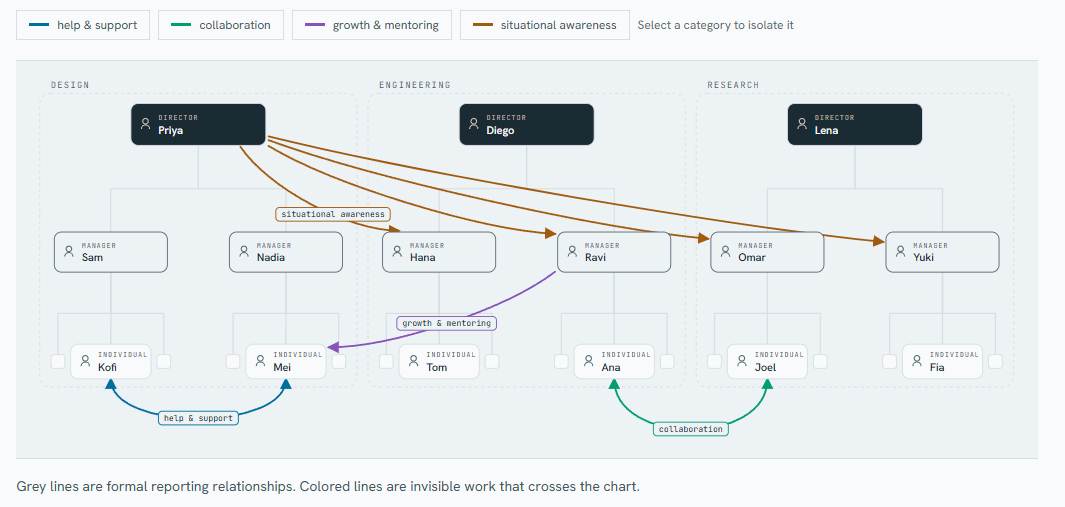
Some key takeaways for me:
- AI is blurring the boundaries between roles: Product managers can now write code, designers can develop functioning prototypes, and engineers can iterate on visual designs. This makes it easier to share a functional version of what you have in mind, but it can also increase anxiety about whose role it is to do these things. Increasingly, a job role may represent the person who is ultimately accountable for the work.
Being accountable and managing your reputation based on the quality of your output, especially in a world of AI-generated content, is now more important than ever.
- AI is making it easier than ever to create awareness, but not understanding: We can now share meeting notes, project updates, and decks in a few clicks, with AI doing most of the heavy lifting.
But more awareness does not necessarily mean more understanding.
In fact, with a greater volume of information available, developing a genuine shared understanding may become even harder.
- We risk losing our connections as AI is making it easier to learn and get feedback independently: As people increasingly lean on AI to understand new topics, brainstorm ideas, and receive basic feedback, we risk losing some of the professional interactions and networks they previously relied on for this support. This could make workplace isolation a real risk.
Creating, and maintaining, a professional community of people you can learn from, exchange ideas with, and turn to for support requires dedicated effort in the age of AI.
Full paper here: https://lnkd.in/ghVNXt9m